
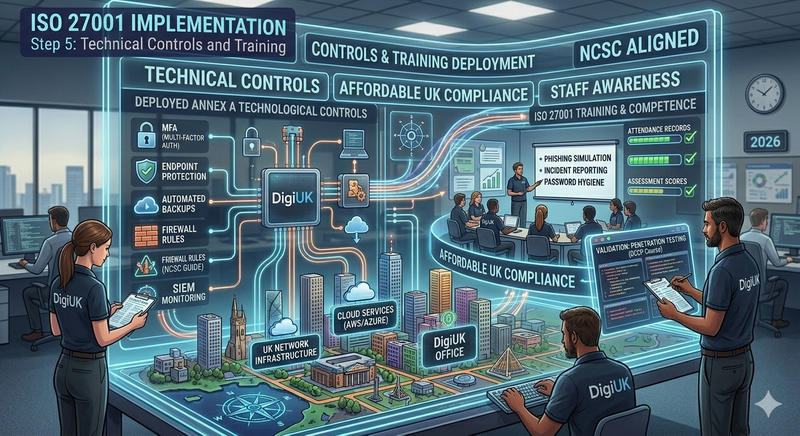
Once your policies are written, you must move from “paper” to “practice.” ISO 27001 Implementation is the phase where you deploy the physical and technical controls defined in your Statement of Applicability. For a UK small business, this is the moment your organization transforms into a hardened target against 2026 cyber threats.
Deploying Technical Controls for Annex A Compliance
Implementation isn’t just about buying software; it’s about configuring it correctly. Under the 2022 update, you must focus on four main control categories.
-
Technological Controls: Setting up MFA, endpoint protection, and automated backups.
-
Physical Controls: Securing office perimeters and entry points.
-
Organizational Controls: Establishing clear incident response workflows.
-
People Controls: Background checks and formal security training.
At DigiUK, we specialise in helping small businesses through this technical hurdle. We provide professional consultancy to ensure your ISO 27001 Implementation is efficient. By focusing on the controls that matter most to your specific network, we help you get certified cheaper while maintaining a high security standard.
Validating Implementation via Penetration Testing
How do you know if your controls actually work? An auditor will look for evidence of “effective implementation.” This is where the DigiUK advantage becomes clear.
Our DCCP Course goes beyond theory. Because we focus on Penetration Testing and Cybersecurity, we can show you exactly how to test your newly implemented controls. If you’ve implemented a new firewall as part of your ISO 27001 Implementation, our technical training teaches you how to scan for open ports and vulnerabilities to ensure the control is actually protecting you from hackers.
The Critical Role of Staff Security Awareness
Clause 7.2 and 7.3 of the standard require that all employees are “competent” and “aware.” Even the best technical ISO 27001 Implementation will fail if a staff member clicks a malicious link.
-
Training Topics: Phishing awareness, password hygiene, and reporting incidents.
-
Evidence: You must keep records of who attended training and their assessment scores for the audit.
Conclusion: Moving Toward the Internal Audit
Successful ISO 27001 Implementation means your security rules are now part of your daily business operations. You aren’t just “doing” security; you are living it.
To explore how the NCSC recommends implementing security for small firms, see the NCSC Small Business Guide. If you want a professional partner to ensure your ISO 27001 Implementation is both affordable and technically sound, DigiUK is ready to assist.