
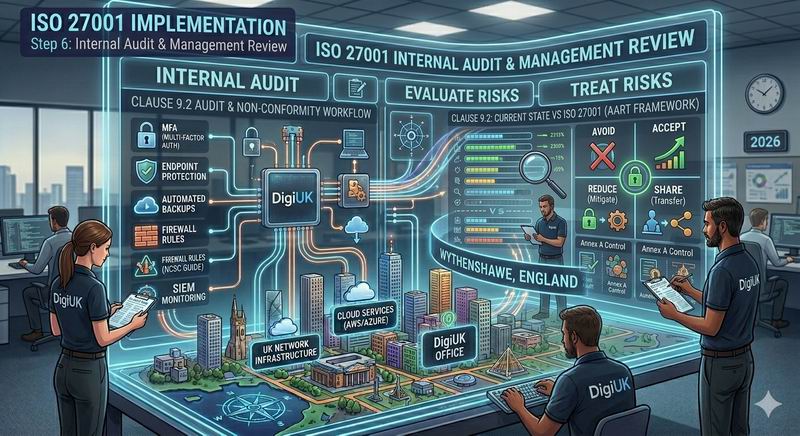
You’ve scoped your ISMS, assessed risks, and implemented controls. Now comes the moment of truth: the ISO 27001 Internal Audit. This stage is a mandatory requirement under Clause 9.2. It acts as a “sanity check” to ensure your security system is actually doing what you claim it is. For UK small businesses, this is the final hurdle before the official certification body arrives.
[H2] Conducting a Professional ISO 27001 Internal Audit The primary rule of an internal audit is objectivity. You cannot “mark your own homework.” This means the person who wrote the policies shouldn’t be the one auditing them. Your ISO 27001 Internal Audit must:
-
Check for Conformity: Does your ISMS meet the standard’s requirements?
-
Verify Effectiveness: Are the controls actually working in practice?
-
Document Findings: You must log “Non-Conformities” (problems) and “Observations” (improvements).
At DigiUK, we provide impartial, professional auditing services. We help small businesses identify gaps early so they can be fixed before the expensive Stage 1 audit. Our goal is to help you get certified cheaper by ensuring you don’t waste money on failed official audits.
The Management Review: Leadership Accountability
Once the audit findings are in, you must conduct a Management Review (Clause 9.3). This is not just a quick chat; it is a formal meeting where senior leadership reviews the audit results, security incidents, and resource needs. A professional ISO 27001 Internal Audit report is the primary input for this meeting.
Proving Controls with Technical Validation
Many internal audits fail because they only look at paper. They check if a policy exists, but they don’t check if the technology is secure.
This is why our DCCP Course is so valuable for implementors. By teaching Penetration Testing and Cybersecurity skills, we empower you to conduct a more rigorous ISO 27001 Internal Audit. Instead of just asking “Is there a firewall policy?”, you will have the skills to test the firewall for vulnerabilities. Technical testing provides the “hard evidence” that UK auditors love to see.
Corrective Actions: The Path to Improvement
If your ISO 27001 Internal Audit finds a problem, don’t panic. Finding a “Non-Conformity” is actually a good thing—it proves your audit process is working. You must:
-
Identify the Root Cause of the problem.
-
Implement a Corrective Action to fix it permanently.
-
Verify the fix in a follow-up review.
Final Readiness for the UK Audit
By the time you finish Step 6, your management team should be fully aware of your security posture. You should have a folder full of evidence, from audit reports to meeting minutes, ready for the external auditor.
Conclusion: Your Bridge to Certification
The ISO 27001 Internal Audit is your insurance policy against certification failure. It ensures that your small business is not just compliant on paper, but resilient in reality.
To see how the UK government recommends assessing your own security, refer to the NCSC Board Toolkit. Ready for a professional, independent set of eyes on your ISMS? DigiUK is here to make your final check affordable and comprehensive.