
If policies are the “laws” of your business, then ISO 27001 Audit Evidence is the proof that you are a law-abiding citizen. One of the biggest mistakes UK small businesses make is having great policies but zero records to show they are being followed. When the auditor asks, “How do I know you perform weekly backups?”, a simple “We just do” will lead to a non-conformity. You need artifacts.
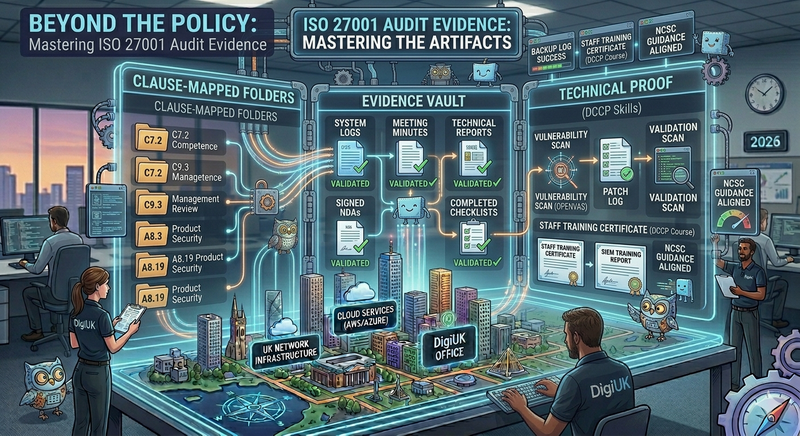
[H2] What Counts as “Hard Evidence” in an Audit? Auditors look for a “trail” of activity. To satisfy ISO 27001 Audit Evidence requirements, you should collect:
-
System Logs: Evidence of successful backups, firewall blocks, and admin logins.
-
Meeting Minutes: Records from your Management Reviews and security briefings.
-
Signed Documents: Training attendance sheets and signed Non-Disclosure Agreements (NDAs).
-
Technical Reports: Output from vulnerability scans and penetration tests.
At DigiUK, we help you automate this collection. By setting up the right technical workflows early, gathering ISO 27001 Audit Evidence becomes a background task rather than a last-minute panic. This professional approach keeps your certification journey affordable and organized.
Using DCCP Skills to Generate Evidence
Technical evidence is the most persuasive type of artifact. This is where our DCCP Course students really shine. Because the course focuses on the “hands-on” side of Cybersecurity, you learn how to generate high-quality ISO 27001 Audit Evidence that leaves no room for doubt.
For example, when auditing Annex A 8.8 (Management of technical vulnerabilities), a student can provide:
-
A Vulnerability Scan Report: Proving they identified the risks.
-
A Patch Management Log: Proving they fixed the risks.
-
A Follow-up Scan: Proving the fix worked.
This “Closed-Loop Evidence” is the gold standard for any UK certification body.
Organizing Your Artifacts: The Evidence Folder
Don’t wait for the audit to start searching your inbox. Create a structured evidence folder mapped directly to the clauses of the standard. If an auditor asks about Clause 7.2 (Competence), you should be able to instantly produce the certificates from your team’s latest security training.
Conclusion: If It Isn’t Written Down, It Didn’t Happen
In the world of compliance, your word is only as good as your records. By prioritizing ISO 27001 Audit Evidence, you turn your audit from a stressful interrogation into a simple demonstration of your professional standards.
To see what the NCSC recommends regarding logging and monitoring for security, check out the NCSC Logging and Monitoring Guidance. Ready to start building a technically sound, audit-ready business? DigiUK is your Manchester-based partner for expert guidance and DCCP training.
Need Help Preparing Audit Evidence?
Good audit evidence begins with clear controls, ownership and review. DigiUK supports UK organisations with gap analysis, risk treatment and audit preparation through our ISO 27001 consultancy in Manchester.