
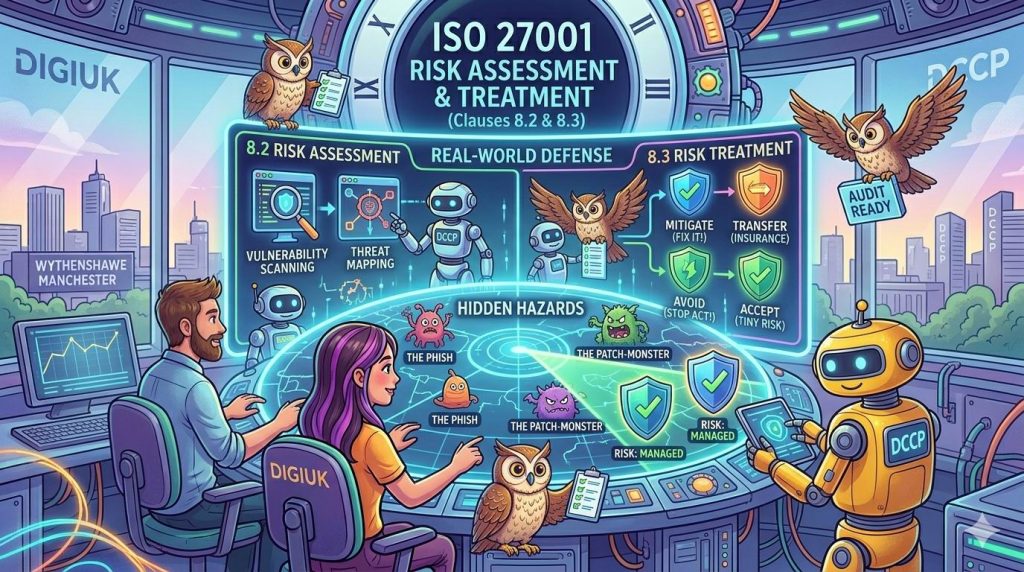
Imagine you are driving a car. You don’t just look at the map before you start your journey; you keep your eyes on the road to spot potholes and hazards as they appear. In cybersecurity, ISO 27001 Risk Assessment and Treatment (Clauses 8.2 and 8.3) is how you keep your eyes on the road. It is the process of regularly scanning your business for new dangers and applying the right “brakes” to keep your data safe.
From Identifying Threats to Taking Action
Operational risk management is a simple, ongoing cycle. To meet the professional standards expected by auditors, your business must follow two specific steps whenever things change:
-
Risk Assessment (Clause 8.2): Look at your systems and ask: What could go wrong, how likely is it, and how badly would it hurt our business?
-
Risk Treatment (Clause 8.3): Decide how to handle the risk. Will you mitigate it (fix it), accept it (if it’s tiny), avoid it (stop doing the risky activity), or transfer it (like getting cyber insurance)?
At DigiUK, we make risk management look easy and approachable. We help you design clear, adorable risk registers that track vulnerabilities without overwhelming your calendar. This structured, professional habit ensures your Manchester business stays secure against evolving digital threats.
Defeating Advanced Threats with DCCP Precision
When a new high-severity exploit hits the news, generic advice won’t save your infrastructure. You need technical depth. This is where the practical skills from our DCCP Course become your ultimate shield.
A DCCP-trained technical lead knows how to execute ISO 27001 Risk Assessment and Treatment at a deep network level:
-
Technical Risk Identification: Using advanced scanning tools to map your network’s actual attack surface and spot unpatched systems.
-
Proportional Treatment: Designing targeted technical fixes—such as isolating legacy servers on a separate virtual network (VLAN)—rather than just writing a policy that tells staff to be careful.
-
Continuous Validation: Running simulated internal attacks to prove that your risk treatment actually worked and that the vulnerability is securely closed.
This data-driven evidence proves to UK certification bodies that your risk process isn’t just guesswork—it is a highly professional technical operation.
Keeping Your Risk Register Alive
An auditor will instantly spot a risk register that was rushed the night before the audit. A professional register is a living document. Whenever you install new software, hire a new vendor, or adopt a new cloud service, update your log. Showing a history of how you assessed and treated risks over time is the easiest way to ace your assessment.
Conclusion: Staying One Step Ahead
Security is not a static destination; it is an ongoing journey of staying prepared. By mastering ISO 27001 Risk Assessment and Treatment, you take complete control of your digital environment and build lasting trust with your clients.
To explore how the UK government recommends evaluating your organizational hazards, check out the NCSC Guidance on Risk Management. Ready to build an unbreakable risk strategy for your firm? DigiUK in Manchester is right here to support you with expert advice and premium DCCP technical training.
Build a practical risk-treatment process with our ISO 27001 consultancy support.