
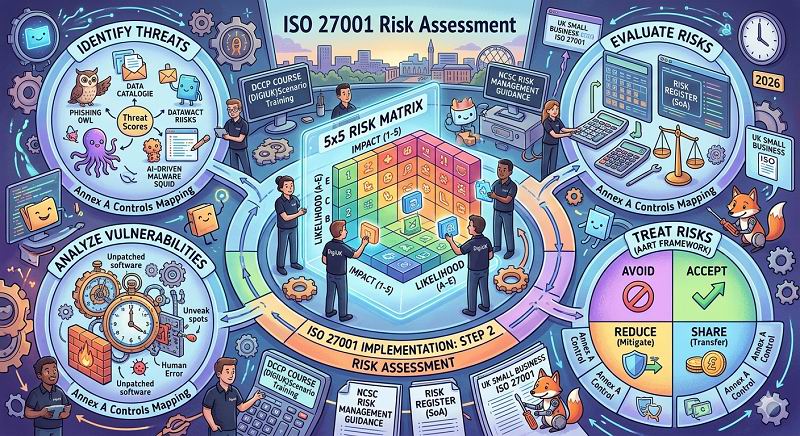
Once you have defined your scope, you must identify the threats facing your assets. The ISO 27001 Risk Assessment is not just a compliance checkbox; it is a strategic tool that tells you where to spend your security budget. In the UK, where the 2026 threat landscape is dominated by AI-driven phishing, a “guesswork” approach to risk will lead to audit failure.
Developing a Repeatable ISO 27001 Risk Assessment Methodology
Clause 6.1.2 of the standard requires your process to be “repeatable.” This means if two different people assess the same risk, they should reach a similar conclusion. For a professional ISO 27001 Risk Assessment, you must define your risk criteria, likelihood scales, and acceptance thresholds.
At DigiUK, we specialize in helping small businesses navigate this complexity. We understand that smaller firms have tighter budgets, which is why we provide a professional, streamlined approach to help you implement all ISO 27001 rules. Our consultancy ensures your small business is ready to get certified cheaper than traditional large-scale firms, without ever compromising on professional quality.
Identifying Threats and Vulnerabilities in 2026
A modern ISO 27001 Risk Assessment must evaluate:
-
Technological Risks: Unpatched vulnerabilities in your cloud stacks.
-
Human Risks: Social engineering targeting your remote UK workforce.
-
Legal Risks: Non-compliance with the UK Data Protection Act 2018.
From Assessment to the ISO 27001 Risk Treatment Plan
Identifying the risk is only half the battle. Clause 6.1.3 requires a formal treatment plan. You have four professional options: Avoid, Accept, Reduce (Mitigate), or Share (Transfer).
Every decision you make during the ISO 27001 Risk Assessment must be documented. This documentation forms the basis of your Statement of Applicability (SoA)—the primary document your auditor will request. DigiUK can manage this entire documentation process for you, ensuring every rule is met with precision.
Bridging the Gap Between Risk and Technical Security
The transition from identifying a risk to selecting the correct Annex A control requires a deep understanding of technical vulnerabilities. While the ISO 27001 Risk Assessment provides the framework, our DCCP Course provides the hands-on expertise in Penetration Testing and Cybersecurity needed to validate those controls. By mastering how hackers actually exploit systems, you ensure your risk treatment isn’t just a paper exercise, but a robust defense that protects your UK business with real authority.
Conclusion: Achieving Affordable UK Compliance
A successful ISO 27001 Risk Assessment aligns your internal security with national best practices. By following a structured methodology, you transform “fear of the unknown” into a manageable, auditable plan.
To see how the UK government views these threats, visit the NCSC Risk Management Guidance. If you are ready to secure your future, let DigiUK guide your small business through the rules and toward an affordable, professional certification.
Turn Risk Assessment into an Effective ISMS
A risk assessment is most valuable when it leads to proportionate, maintained controls. Our ISO 27001 consultancy in Manchester helps organisations build practical certification-ready systems across the UK.