
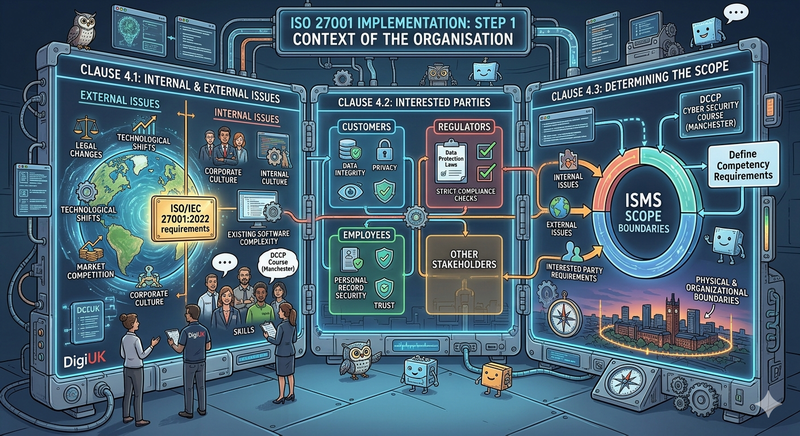
To build a strong security framework, you must understand the “land” your business sits on. In ISO 27001 implementation, this is known as the “Context of the Organization.” Found in Clause 4, this rule requires you to determine exactly what matters to your business before you apply a single technical control.
1. Internal and External Issues (Clause 4.1)
You cannot protect data without understanding your environment. You must identify “issues” that affect your Information Security Management System (ISMS).
-
External Issues: These include legal changes, technological shifts, or market competition. For example, staying updated on the latest ISO/IEC 27001:2022 requirements is a critical external factor for compliance.
-
Internal Issues: These are factors within your company, such as your corporate culture, existing software complexity, and the specific skills of your staff.
2. Understanding Interested Parties (Clause 4.2)
Who has a stake in your security? ISO 27001 calls these “Interested Parties.” You must list them and identify their requirements. This typically includes:
-
Customers: Who expect their private data to be handled with integrity.
-
Regulators: Who require strict adherence to data protection laws.
-
Employees: Who need their personal records kept secure.
3. Determining the Scope (Clause 4.3)
The “Scope” defines the boundaries of your ISMS. You don’t have to certify every department at once. For instance, many organizations choose to focus their initial certification on high-risk areas. If you are training your team to handle these technical challenges, integrating a professional DCCP Cyber Security Course in Manchester can help define the competency requirements within your scope.
When defining your scope, you must consider:
-
The internal and external issues identified.
-
The requirements of your interested parties.
-
The physical and organizational boundaries of your business.
4. The ISMS Process (Clause 4.4)
Finally, you must establish and maintain the ISMS. It is a cycle of continuous improvement, not a “set-and-forget” project. By clearly defining your context, you ensure that your security efforts are efficient and audit-ready.
Define a defensible ISMS scope with our ISO 27001 implementation support.