
Welcome back to the next comprehensive session of our Enterprise Network Specialist training curriculum! Following our thorough review of web application security and injection defenses, we advance into the next critical technical domain: Incident Response and Digital Forensics.
Building upon our previous exploration of threat intelligence, malware analysis, and perimeter controls, today we teach our students how enterprise incident response procedures operate, how digital evidence is legally preserved, and how forensic investigators analyze disk and memory artifacts within a controlled laboratory environment.
1. Introduction to Incident Response and Forensics
When security breaches occur despite multi-layered defenses, an organization’s ability to respond rapidly and methodically determines the extent of the damage. Incident Response (IR) provides a structured framework for detecting, containing, and eradicating threats, while Digital Forensics ensures that evidence is gathered legally for root-cause analysis.
-
The NIST Incident Response Lifecycle: Standardized phases consisting of Preparation, Detection & Analysis, Containment, Eradication & Recovery, and Post-Incident Activity.
-
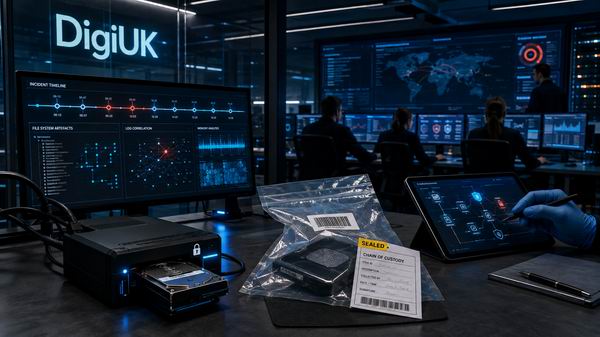
Chain of Custody: The chronological documentation and paper trail showing the seizure, custody, control, transfer, analysis, and disposition of digital evidence, ensuring admissibility in legal proceedings.
-
Volatility Order of Preservation: When acquiring evidence during live triage, investigators must capture volatile data first (RAM, active network connections, running processes) before examining non-volatile storage (hard drives, solid-state drives).
2. Core Concepts of Evidence Acquisition and Triage
Performing digital forensics requires specialized tools and strict adherence to integrity protocols to ensure original system files are never altered during examination.
Important Note: Never analyze an incident directly on a compromised production machine. Always create bit-stream forensic images and perform all analytical work on isolated copies.
Key Forensic Methodologies:
-
Bit-Stream Imaging: Creating a sector-by-sector copy (e.g., using E01 or RAW formats) of a storage medium to preserve deleted files, slack space, and unallocated clusters.
-
Memory Dump Analysis: Extracting random-access memory contents to uncover injected code, active network sockets, decrypted encryption keys, and running malware strings.
-
Log Timeline Reconstruction: Correlating event logs from operating systems, firewalls, and proxy servers to map the exact timeline of an attacker’s movement.
3. Step-by-Step Hands-On Lab: Collecting Volatile Artifacts and System Logs
Follow these sequential commands in your training lab to review live system sockets and extract volatile artifact baselines:
Bash
# Capture active network connections and associated process IDs on a test system
ss -tunap

# Inspect system authentication logs for failed login attempts and potential brute-force patterns
grep "Failed password" /var/log/auth.log
-
Step 1: Review active system logs in your isolated laboratory to identify indicators of compromise (IoCs) left during simulated breaches.
-
Step 2: Capture live system traffic and socket mappings alongside Wireshark to record active communication channels.
-
Step 3: Document hash checksums (SHA-256) of all acquired forensic artifacts in your chain of custody logbook to guarantee data integrity.
4. Best Practices for Incident Management and Readiness
Maintaining an effective incident response posture requires continuous preparation, clear escalation paths, and routine testing:
| Response Focus | Description | Action Item |
| Playbook Development | Document predefined steps for handling ransomware, phishing, and data exfiltration. | Conduct tabletop exercises with IT and executive teams quarterly. |
| Forensic Readiness | Ensure logging and endpoint monitoring tools are active and properly configured. | Centralize log collection using an SIEM platform with immutable storage. |
| Root-Cause Analysis | Determine how the initial compromise occurred to prevent recurring incidents. | Update firewall rules, patches, and policies based on post-incident findings. |
-
Communication Planning: Establish secure out-of-band communication channels for the incident response team during an active crisis.
-
Legal and Compliance Coordination: Ensure proper notification procedures are followed in alignment with data protection regulations and industry standards.
External Resources & Further Reading
-
Review incident handling guides via the NIST Special Publication 800-61 Rev. 2.
-
Explore computer forensics frameworks at the SANS Institute Reading Room.
-
Read our previous training module on Advanced Web Application Security and Injection Defenses.
Build practical incident-response skills through our Digital Cybersecurity Career Programme in Manchester.