
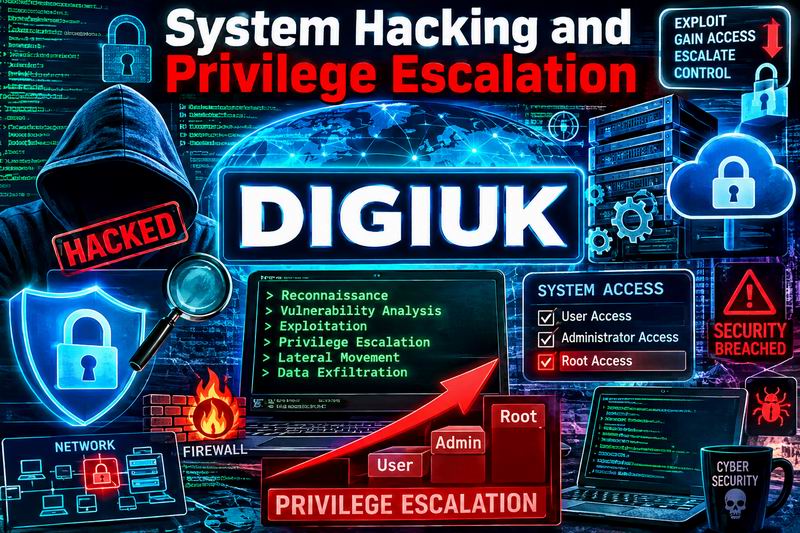
Welcome back to the next comprehensive session of our Enterprise Network Specialist training curriculum! Following our deep dive into network enumeration and service discovery, we are moving into the next critical phase of cybersecurity: System Hacking and Privilege Escalation.
Building upon our previous exploration of system exploitation workflows, today we teach our students how ethical hackers safely gain initial access, harvest credentials, and escalate privileges from a standard user account to full administrative control within a simulated test environment.
1. Introduction to System Hacking and Privilege Escalation
Once network enumeration reveals unpatched vulnerabilities or misconfigured services, the system hacking phase begins. Privilege escalation is the act of exploiting bugs, design flaws, or configuration oversights in an operating system or application to gain elevated access to resources that are normally protected.
-
Vertical Privilege Escalation: Moving from a low-privileged user account up to an administrator, root, or SYSTEM level account.
-
Horizontal Privilege Escalation: Accessing another user’s account with the same privilege level (e.g., jumping from standard user Bob to standard user Alice).
-
Post-Exploitation Strategy: Establishing persistence, dumping password hashes, and clearing pathways for authorized audit validation.
2. Core Concepts and Common Vector Types
Understanding how systems leak privileges helps security engineers harden infrastructure against real-world threat actors.
Important Note: Always ensure you have explicit written authorization, adhere strictly to the Computer Misuse Act 1990, and operate only within an isolated training laboratory.
Key Escalation Vectors:
-
Misconfigured File Permissions: Executable files or scripts running with root privileges that can be modified by standard users.
-
Sudo Rights Misconfiguration: Linux users permitted to run specific administrative commands (e.g.,
sudo findorsudo vim) without a password prompt. -
Unquoted Service Paths: Windows services whose executable paths contain spaces and lack quotation marks, allowing attackers to hijack execution flows.
3. Step-by-Step Hands-On Lab: Identifying Privilege Escalation Gaps
Follow these sequential commands in your training lab to identify local privilege escalation vectors on a test system:
Bash
# Check current user identity and assigned group privileges
whoami && groups

# List sudo permissions granted to the current user account
sudo -l
-
Step 1: Run automated enumeration scripts (such as LinEnum or WinPEAS) in your isolated lab to quickly flag system weaknesses.
-
Step 2: Analyze Sudo privileges or file permission flags alongside Wireshark or local system logs to observe administrative privilege transitions.
-
Step 3: Document discovered vulnerabilities and apply immediate remediation rules to close the security gap.
4. Best Practices for Hardening Systems Against Escalation
Securing endpoints against unauthorized privilege elevation requires disciplined system administration and continuous hardening:
| Hardening Focus | Description | Action Item |
| Principle of Least Privilege | Ensure users and services operate with the minimum permissions necessary. | Remove unnecessary sudo rights and audit user groups. |
| File Permission Auditing | Prevent standard users from modifying system binaries or configuration files. | Enforce strict access control lists (ACLs) on critical paths. |
| Patch Management | Keep operating systems and third-party software updated against local exploit vectors. | Automate regular kernel and software patching cycles. |
-
Service Isolation: Run services under dedicated low-privileged service accounts rather than root or SYSTEM.
-
Continuous Monitoring: Deploy Endpoint Detection and Response (EDR) solutions to flag abnormal process spawns and privilege changes.
External Resources & Further Reading
-
Explore advanced exploitation techniques via the Offensive Security Resources.
-
Review endpoint security benchmarks at the CIS Benchmarks Portal.
-
Read our previous training module on Network Enumeration and Vulnerability Discovery.
- See Our DCCP Cybersecurity course