
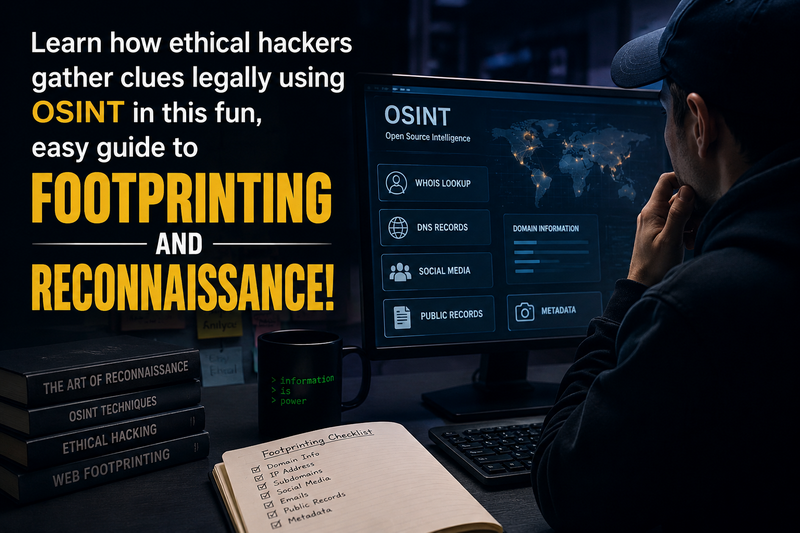
Have you ever played hide-and-seek and looked for clues—like a rustling curtain or a pair of shoes peeking out from behind a door? In the world of cybersecurity, digital detectives do the exact same thing before they ever touch a keyboard!
This sneaky (but totally legal!) clue-gathering is called Footprinting and Reconnaissance. Today, we are going to learn how cyber superheroes use their digital spyglasses to study a target safely using OSINT!
What is Footprinting and Reconnaissance?
Imagine you are planning to protect a giant candy factory from mischievous raccoons. Before you build a fence, you need to walk around the building, count the windows, find the back doors, and see when the guards take their breaks.
In ethical hacking, Footprinting is the process of gathering as much information as possible about a target network. We do this to find where the weak spots might be so we can patch them up before the bad guys find them!
There are two ways digital detectives do this:
-
Passive Reconnaissance : Gathering clues without ever directly touching the target’s system. It’s like looking at a house from across the street with binoculars.
-
Active Reconnaissance : Interacting directly with the target’s system to see how it responds. It’s like walking up to the front door and turning the handle to see if it’s locked.
The Magic of OSINT (Open Source Intelligence)
You don’t need a super-secret spy gadget to gather footprints. In fact, most of the best clues are completely public! We call this OSINT (Open Source Intelligence).
Here are three ways cybersecurity experts gather public clues legally:
1. Searching the Web Map
Ethical hackers look at public domain registries to see who owns a website and when it was made. It’s like looking up a business in a giant digital phonebook!
2. Peeking at Social Media
Sometimes, employees accidentally share too much information online. A photo of an office desk might show a sticky note with a password, or reveal what kind of computers the company uses.
3. Finding Hidden Details in Files
Photos and PDF documents contain hidden data called metadata. This invisible data can reveal exactly what kind of camera was used, the GPS location of where a photo was taken, and even the software version used to make a document!
The Golden Rule: Always keep your magnifying glass focused on public information! If you want to learn how to use professional tools to discover these hidden clues safely and legally, you can join our hands-on Ethical Hacking Course in Manchester and practice in our secure virtual labs.
The Professional Way to Investigate
Real cybersecurity experts always follow a strict code of ethics. Organizations like the EC-Council Official Website set global standards to make sure that footprinting is only ever used to help protect businesses, never to spy on people unfairly. When we gather clues, we do it to make the internet a safer playground for everyone!