
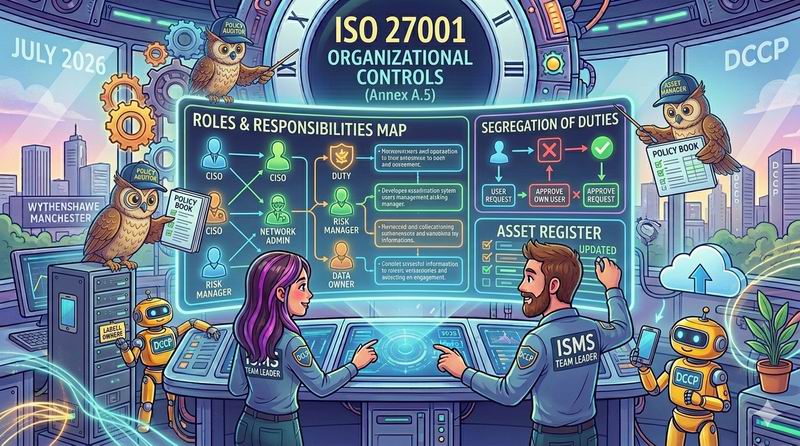
When you build a great football team, everyone needs to know their exact position on the pitch. Security works the exact same way. You can have the most expensive firewalls in the world, but if nobody knows who is responsible for checking them, your defense will break down. This is why ISO 27001 Organizational Controls (found in Annex A.5) are so critical. They act as your company’s internal law book, defining exactly who does what to keep data safe.
Setting Up Clear Security Rules and Duties
Annex A.5 focuses heavily on structure, accountability, and clarity. To satisfy an external auditor, your business needs to put several professional corporate pillars in place:
-
Information Security Policies: Write down clear, simple rulebooks that explain how your company handles passwords, clean desks, and remote work.
-
Defined Roles: Explicitly assign who is in charge of your network, who approves access requests, and who manages your backups.
-
Segregation of Duties: Ensure that no single person has total control over a critical process (for example, the person who requests a new system admin account shouldn’t be the same person who approves it).
-
Contact with Authorities: Maintain a tidy list of up-to-date emergency contacts, including local police, action fraud, and utility providers.
At DigiUK, we make structural planning look completely adorable and easy to absorb. We help you design clear, friendly organizational charts that show your team exactly where they fit into the compliance puzzle. This highly professional habit ensures your Manchester business operates smoothly without any confusing overlaps.
Hardening Infrastructure with DCCP Technical Controls
Organizational controls aren’t just administrative text on a piece of paper; they must dictate how your actual technology is configured and controlled. When deploying ISO 27001 Organizational Controls, having a technical leader who has passed our DCCP Course ensures your corporate rules map perfectly to your live systems.
A DCCP-trained technical expert implements Annex A.5 at an infrastructure level by:
-
Enforcing Role-Based Access: Configuring active directory and cloud groups so that staff members can only access the precise files required for their specific job role.
-
Structuring Change Management: Setting up technical approval pipelines so that system modifications must be verified by a peer before going live on production servers.
-
Auditing Asset Ownership: Creating a live, automated asset register that links every laptop, server, and cloud database directly to a responsible owner.
This tight link between high-level policy and real-world network settings provides the exact technical evidence UK auditors look for during an evaluation.
Reviewing and Updating Your Governance
Your company rules shouldn’t sit in a dusty folder gathering dust. At least once a year, or whenever your business grows, your leadership team should sit down to review your policies. Showing an auditor that you actively update your organizational boundaries proves your framework is mature and perfectly aligned with your business goals.
Conclusion: A Solid Foundation
By organizing your team and setting clear boundaries, you create a rock-solid foundation for all the other technical security blocks to rest upon.
To read more about how the UK government suggests structuring organizational security roles, check out the official NCSC Operational Security Guidance. Ready to build a flawless role map for your enterprise? DigiUK in Wythenshawe is standing by to help you with premium consulting and advanced DCCP technical training!
Need help implementing organisational controls? Explore our ISO 27001 consultancy in Manchester.